
CMH Ltd Distributors of Testing Equipment and Labware Lok-Test System
 
 | SERVICE  -  FIRST AND LAST ||  FAX +44 (0) 1903 751188  |  PHONE +44 (0) 1903 751133 

 Purpose

The LOK-TEST measures accurately the compressive strength in-place of newly cast structures for

·

Evaluating the timing of safe and early loading operations of maturing elements or structures

·

Evaluating the quality of the critical cover layer protecting the reinforcement in the finished structure


 Principle

A steel disc, 25 mm in diameter positioned 25 mm from the surface is pulled centrally against a 55 mm inner diameter counter pressure on the surface. The concrete in the strut between the disc and the counter pressure is being compressed; hence the pull force "F" is a direct measure of the compressive strength.
Loading is performed either to a required force, in which case the test is nondestructive, or to the peak-load, only generating a slightly raised 55 mm circumferential crack on the surface.
The disc has to be cast into the concrete beforehand. A number of LOK-TEST inserts are available for this purpose, either attached to the formwork or for floating in the top faces of castings, page 27.

 Precision and variation

The special feature of the LOK-TEST is that an accurate estimation of the strength on-site can be obtained, as the peak-force (the pull-out force) correlates accurately to the compressive strength measured by standard cylinders or cubes in the laboratory. More than 25 years of calibration experience from all over the world, comprising numerous major correlations, indicates one general correlation to standard specimen strength as shown below for all normal concrete mixes. Only for the use of lightweight aggregates another correlation has been found.


28 major correlations between Lok-Test and standard specimen compressive strength,
c.f. Petersen, C.G.: "Lok-Test and Capo-Test pullout testing, twenty years experience",
British Institute of NDT, University of Liverpool, U.K., April 1997

The recommended relationships between Lok-Test and Capo-Test pullout force and the
compressive strength determined by standard cylinders or standard cubes. The 95% confidence
limits are the dotted lines for 16 mm and 32 mm maximum aggregate size

On a 95% confidence level, and for an average of 4 tests, the precision of the LOK-TEST estimate on normal concrete is within ± 6% compared to standard specimen tests (cylinders or cubes) for a maximum aggregate size of 38 mm using the general correlations indicated.

The variation of the LOK-TEST is in the range of ± 8% on normal concrete.

 Testing examples


LOK-TEST being performed on a wall for quality control of the finished structure. "H" on the display indicates the Highest pull force obtained. The L-40 Control Insert is used


Testing for in-place concrete quality control on a slab. The L-49 Floating Insert is being used. Maturity is measured with the COMA-Meter inserted in front of the knee of the technician.


LOK-TEST performed from the bottom of a slab, through the formwork, for safe and early
form removal. The insert used is the L-42 Early Stripping Insert with L-44 Steelplate attached
to a removable plug through a porthole in the formwork. COMA-Meters are used for timing of the LOK-TEST.

 LOK-TEST Inserts and ordering numbers

The inserts for the testing are supplied in four different configurations and in two strength classes.

·

Control Inserts for nailing to wooden formwork. The formwork has to be removed before testing.

·

Early Stripping Inserts with L-44 Steel Plate for attachment to a removable plug through a porthole, for use when testing has to be performed before the formwork is removed.

·

Disc and Stem, only, for replacement of used inserts

·

Floating Inserts for floating in top surfaces of castings


Two strength classes of inserts are available, one for 0-50 kN and another for 0-100 kN pullforce:

The inserts may be re-used provided they are pulled out, thread locked and coated with a coating agent, L-29, before re-use. For pulling out of the disc an extra travel ring is available, L-26, delivered separately. For testing of the 0-100 kN inserts the special pullbolt with flange is needed, L-17-1, and the C-141 coupling.

 LOK-TEST Instruments and ordering numbers


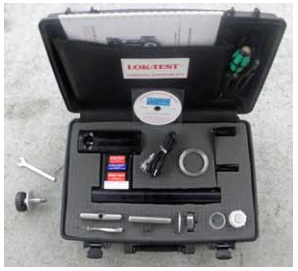
Three types of hydraulic pullmachines are available in the L-10, L-11 and L-12 LOK-TEST Kits.

L-10 LOK-TEST Kit

The hydraulic, hand-operated pullmachine comes calibrated with a 0-40 kN analog gauge installed.
Alternatively, the instrument can be supplied with a 0-25 kN gauge (order no. L-10-1) or a 0-60 kN gauge (order no. L-10-3).
The accuracy of the pullmachine is within ± 0.6%.
The pullmachine needs to be re-calibrated once a year, or before, if serviced or damaged.

The hydraulic pullmachine has a 0-100 kN precision electronic gauge installed with memory for storage of test results (peak-value, time and date of testing).
The peak-value is shown after a test has been terminated.
The internal accuracy of the gauge is 0.01 kN.
The display is showing the pull force in 0.1 kN digital increments.
The pull machine needs to be re-calibrated once a year, or before, if serviced or damaged.

L-11 LOK-TEST Kit

As a special feature the L-12-1 pullmachine has automatic loading rate build in.
The machine has a 0-100 kN precision electronic gauge installed with memory for storage of test results (peak-value, time and date of testing).
The peak-value is shown after a test has been terminated.
The internal accuracy of the gauge is 0.01 kN.
The display is showing the pull force in 0.1 kN digital increments.
The pull machine needs to be re-calibrated once a year, or before, if serviced or damaged.

L-12 LOK-TEST Kit

Note: The pullmachines illustrated may also be used for other types of tests as well, e.g. the CAPO-TEST, the BOND-TEST, the TORQ-TEST and the DSS-TEST and the POWER. The recommended pullmachine for all the tests is the L-11-1 hydraulic pull machine supplied in the L-11 LOK-TEST Kit.

 Calibration unit L-30

0-100 kN working range.

Accuracy of ± 0.05 kN in 0.1 kN increments.

Comes with calibration certificate.


Detailed information information on all of our product ranges can be found in our catalogue, available for download in the Products area.

CMH Ltd, Unit 3, Winston Business Centre, Chartwell Road, Lancing, West Sussex, UK|  FAX +44 (0) 1903 751188  |  PHONE +44 (0) 1903 751133